Stay in Sync With the Thinking, Not the Output
Merging hundreds of agent-written PRs without reading them is one path. Reading every diff line by line is another. The better path is to keep agent velocity without giving up deep human understanding—by treating human-AI synchronization as an engineering problem.
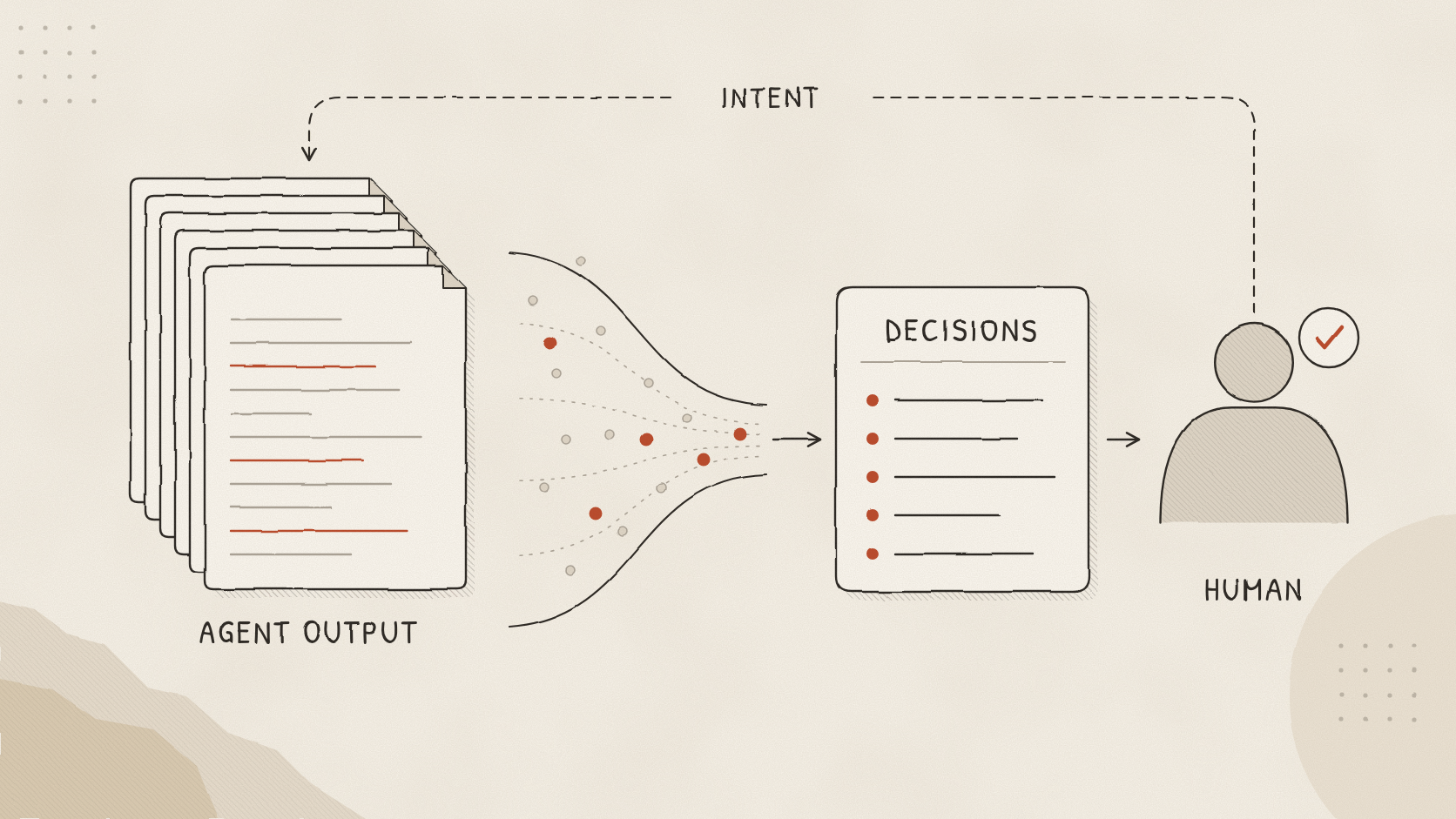
There is a growing argument in software engineering right now: stop reading pull requests.
Let coding agents write the implementation. Put strong tests, linters, and verification loops in front of them. When the checks pass, merge—even if that means merging dozens or hundreds of PRs a day. Treat generated code the way we already treat compiled binaries: you verify the behavior, not the assembly.
It is easy to see why people are taking that path seriously.
Once a team runs agents in parallel, the old workflow breaks immediately. You hand an agent a task before a meeting. An hour later you come back to forty changed files, a new test suite, updated documentation, and a confident summary. Everything is green. Three other agents are waiting with piles of their own.
If you insist on reading every diff line by line, you become the slowest component in the system. The agents wait, the queue grows, and you give up the real advantage of fast agentic iteration.
So the debate keeps collapsing into two camps: read everything and crawl, or stop reading and let the agents fly.
I think both camps miss the better path.
We should not compromise the speed of an agent-driven workflow that can ship a hundred PRs a day. That velocity is genuinely valuable. At the same time, we should not accept a world where the people responsible for a system slowly lose their understanding of how it works.
The way out is not to read faster, and not to stop caring about what is inside the box. It is to elevate something most teams are still treating as an afterthought into a real engineering discipline: how humans and agents think together and stay in sync while moving at machine speed.
Stay in sync with the thinking, not the output.
Why “just merge it” fails quietly
The no-review camp is right about one thing: uniform, line-by-line diff review is over. At agent velocity, human eyes on every changed line do not scale, and pretending they do only slows teams down without actually guaranteeing quality.
What the no-review camp underestimates is what happens to the humans who still own the product.
A compiler takes a clear, formal specification and translates it mechanically into machine code. An agent does not. An agent takes partial, ambiguous human intent and fills in dozens of quiet judgment calls along the way—a schema shape, a retry policy, a caching boundary, a fallback assumption, a shortcut around an awkward module.
When those choices merge silently, day after day, the team accumulates comprehension debt.
Like technical debt, comprehension debt does not hurt on the day you take it on. Throughput looks extraordinary. The merge counter climbs. Nothing is waiting on a person.
It hurts three weeks later—when an incident hits a corner of the system nobody can explain, when two features collide because they rely on incompatible assumptions, or when an engineer gives an agent a confident instruction based on an architecture that stopped being true last month.
Comprehension debt also compounds. As I wrote in Code Is Cheap. Taste, Intent, and Eval Are Not., an agent’s work is only as good as the intent it receives and the evaluation that checks it. Intent comes from people. People who have lost touch with the actual system write fuzzier intent, miss subtle regressions that pass the tests, and hand the agents a worse starting point on the next cycle.
That is why “just merge it and trust the checks” is incomplete. People are not in the loop mainly to catch syntax errors or spot typos. They are in the loop because they hold direction, taste, and accountability—and none of those survive if the team gets lost inside its own codebase.
The usual framing treats this as a tradeoff: high agent velocity or deep human understanding, pick one.
I don’t think it is a tradeoff. I think it is a missing engineering layer.
Comprehension is now an engineering surface
Recently, Andrej Karpathy—the person who gave us the phrase vibe coding—pointed directly at this bottleneck. As language models take over more of the autonomous legwork, he noted, human work rises up the abstraction ladder into oversight and understanding. And because intelligence and code are increasingly abundant, we do not have to keep squinting at walls of raw text. We can spend compute to render AI output into formats humans absorb far faster: tighter technical prose, diagrams, interactive HTML pages, even bespoke explainer videos that you watch once and throw away.
That observation is important, and I think it points to something even larger when you bring it into software engineering.
Right now, most teams treat human comprehension as an ad-hoc prompting habit. When you get confused by a messy PR, you ask an assistant to explain it. Meanwhile, almost all of the real engineering investment goes to the generation side—better harnesses, parallel sandboxes, faster CI, automated fix loops—leaving the human on the receiving end with the same raw git diff we have used for twenty years.
If compute is cheap enough to produce two hundred PRs a day, it is cheap enough to engineer how humans understand those two hundred PRs.
This starts with noticing that output and thinking scale differently.
Output scales with compute. An agent can write three thousand lines of code between two meetings, and a fleet of agents can open a hundred pull requests before dinner.
Decisions scale much more slowly. Across a hundred PRs in a week, most of the diff is consequence: wiring, tests, refactors, boilerplate, edge-case handling. The choices that actually reshape the system might fit on a single page—a new data boundary, a tradeoff between consistency and latency, a changed permission rule, an assumption about user behavior, or one thing deliberately left out.
A human cannot read three hundred thousand lines of code a week and keep a clear head. A human can stay deeply synchronized with the decisions behind them—if the engineering process surfaces those decisions in forms designed for human thinking.
So the practical question becomes:
What is the smallest set of things a human must hold to deeply understand a fast-moving system?
My working answer has four parts:
- Intent. What is this supposed to do now, and for whom?
- Decisions. What was chosen, what was rejected, and why?
- Evidence. How do we know it works, and what remains unproven?
- Boundaries. What must not change without a person saying so?
If you hold those four, you can let dozens of routine PRs merge without reading their diffs and still have a deep, accurate model of the system. If you read every line and cannot answer them, you are already out of sync.
There is a simple test for whether your understanding is real: prediction.
Before you open the result—or before a new requirement lands—can you predict how the system behaves in a case nobody has tried yet, and which parts the next change will have to touch? When prediction works, your mental model matches the system. When you are surprised, you have found the exact place where they diverged.
Surprise is the signal. It tells you where human attention belongs.
Keep velocity: block rarely, on purpose
If a human has to approve every PR, the human is the speed limit. If a human never inspects how the system is changing, the human is decoration.
To keep high-velocity agent iteration without losing the system, you have to separate what blocks a merge from how humans stay in sync.
The split rests on one question: can this decision be undone cheaply?
Most decisions inside a hundred-PR-a-day workflow can be. A helper function, an internal refactor behind a stable interface, a UI adjustment, a test expansion, a localized bug fix. If one of these turns out to be wrong, it is cheap to revert or rewrite. For these, the agent should not wait on a person. Once the automated checks pass, the change should move—and emit a compact record of what it decided into the human comprehension stream.
A small fraction of decisions cannot be undone cheaply. A destructive schema migration. A public API contract. A permission or authentication change. A dependency the whole system will lean on. Anything that touches money or user data. For these, the agent should stop and ask, in a form a person can decide in two minutes: the question, the options, the tradeoffs, and a recommendation.
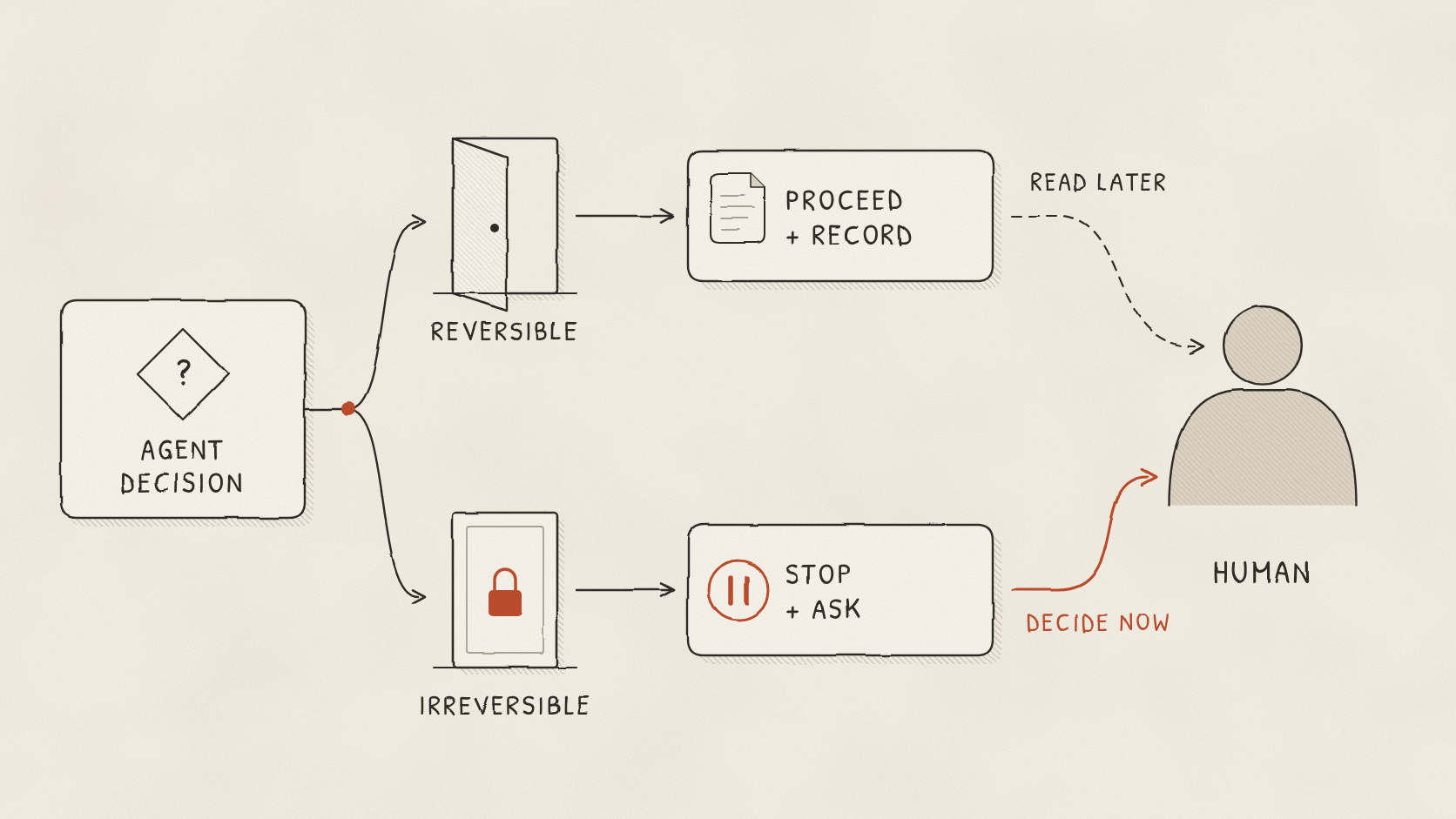
This puts humans on two different clocks.
For irreversible decisions, the human is a synchronous gate—and a fast one, because almost nothing else is competing for that gate.
For reversible decisions, the human is not a blocker at all. The PRs flow at agent speed, while the human catches up asynchronously on the thinking behind them—grouped, compressed, and rendered for understanding rather than raw diff inspection.
The agent never stalls waiting on a person for something easily reversed. And the person should not discover, after the fact, a choice that cannot be undone.
That second half cannot rely on an agent’s good intentions alone. People define the irreversible boundary in advance, and engineering checks enforce it—CI rules, CODEOWNERS, migration guards, and policy checks that automatically halt changes touching protected surfaces until a human signs off.
Key insight
High agent velocity and deep human understanding stop fighting each other when you gate only what cannot be undone—and engineer how humans absorb the thinking behind everything else.
Engineering the co-thinking loop
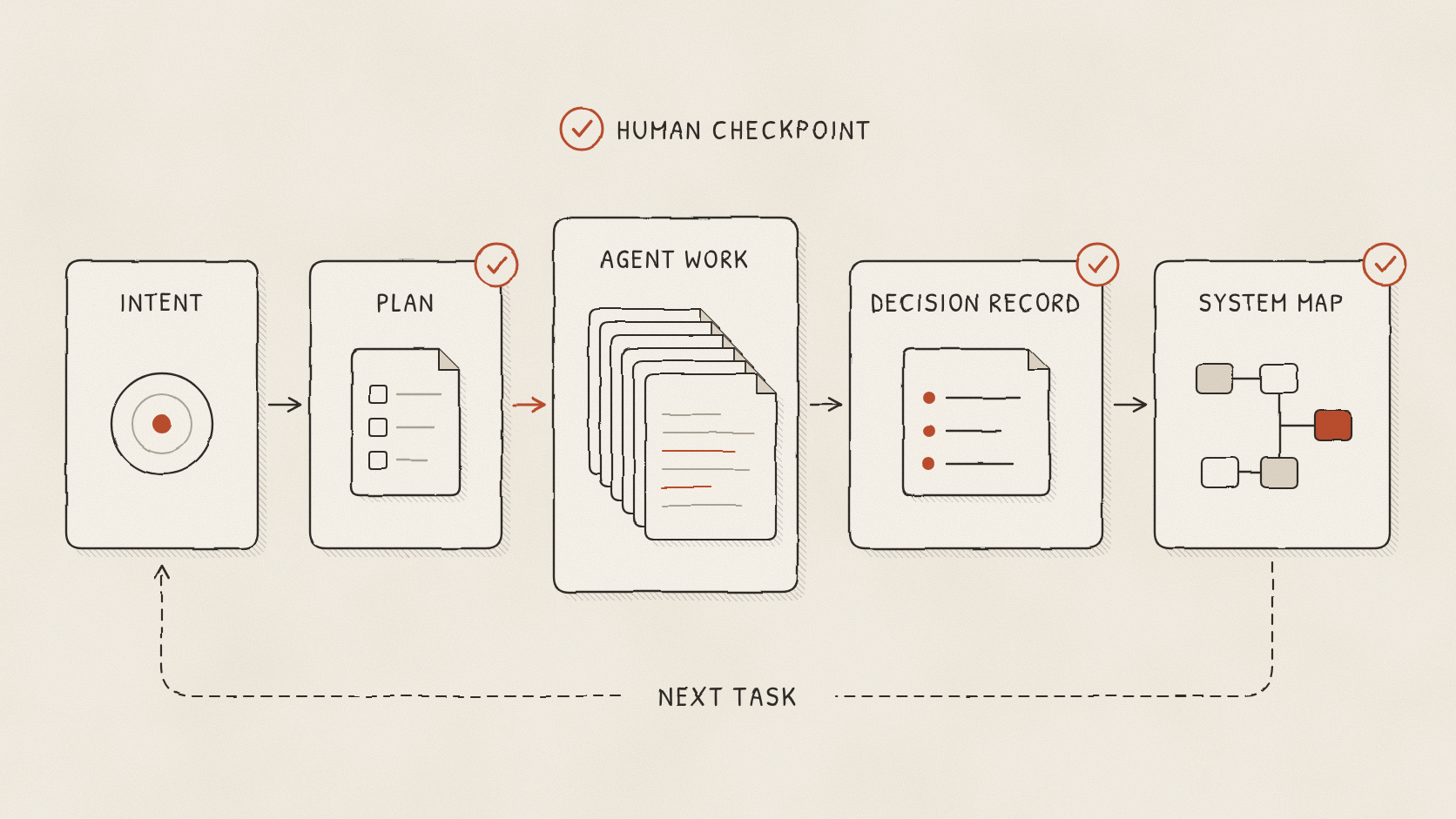
Saying “stay in sync with the thinking” is easy to nod at. Elevating it to an engineering practice means building specific artifacts and checkpoints into the workflow itself—so co-thinking with agents happens by default, not only when someone remembers to ask.
1. Think together before code exists
The cheapest moment to synchronize is before a single file is touched.
Before an agent starts a non-trivial task, have it restate the goal in its own words, surface its assumptions, propose an approach, and name what it will leave alone. That fits on one page. Correcting a flawed assumption on one page takes two minutes. Unwinding the same misunderstanding across forty merged commits costs an afternoon.
This is where humans and agents actually think together. Review the plan the way you would think through a design with a colleague. Once the intent and boundaries are aligned, the code that follows needs far less of you.
2. Emit a decision record, not just a PR summary
Most AI-generated PR descriptions are summaries. A summary says what was done. A decision record says what was chosen. They sound close and they are not.
“Implemented caching for the report endpoint” is a summary.
A decision record says: cached at the query layer rather than the HTTP layer, because results are identical for every user with the same role and an HTTP-layer cache could not be shared across sessions. Invalidation is time-based at five minutes, which assumes reports can be slightly stale. Behavior under concurrent writes was not verified.
Make a minimal record part of every meaningful change or batch of changes:
## Decision record

Intent as understood: [one or two sentences]

Decisions
- [choice] instead of [alternative], because [reason]. Reversible: yes / no

Assumptions
- [something taken as true without checking]

Deviations from the plan
- [what changed, and why]

Evidence
- Verified: [what ran, and the result]
- Not verified: [what remains unproven]

Where a careful owner should look first
- [file, invariant, or behavior]
That last line does a disproportionate amount of work. Asking the agent “what here would surprise the person responsible for this system?” is still the fastest way I know to locate the ten lines worth reading inside a two-thousand-line change.
3. Spend compute on comprehension artifacts
This is the piece most engineering teams have not built yet.
If agents are generating code at high speed, do not force humans to reconstruct architectural change by reading raw diffs or scrolling through thirty separate PR descriptions. Build a rendering step into the workflow that turns agent work into throwaway artifacts built specifically for human understanding.
Depending on the change, that might be:
- A compact diagram showing how data flow or state transitions shifted across a batch of merged PRs.
- A single self-contained HTML walkthrough that groups today’s changes by intent, highlights touched boundaries, and lets an engineer toggle between before-and-after behavior.
- A behavioral trace comparing real inputs and outputs rather than implementation lines.
These artifacts are not documentation you have to maintain forever. Like the custom explainers Karpathy pointed to, their job is to transfer an accurate mental model into a human head in two minutes instead of twenty, and then get out of the way.
4. Partition the codebase by risk, not PR count
Treating every PR as equally worthy of human attention guarantees either gridlock or rubber-stamping. Divide the codebase into explicit zones instead:
- Core. The data model, authorization, money, public interfaces, and the invariants everything else leans on. People read every line here, and often write it themselves.
- Behavior. Most product logic. Let checks carry routine merges, then stay in sync through tests-as-specification, decision records, and comprehension artifacts—opening the raw code only where something surprises you.
- Leaf. Glue, scripts, one-off views, internal tooling, scaffolding. Let agents move freely, rely on automated checks, and sample occasionally.
Have the harness tag every change with the zones it touches. Forty leaf-zone PRs merged in an afternoon and a four-line change to the permission model do not belong in the same review queue.
5. Keep a living system map, and review the map’s diff
Every real system deserves a short, plain document explaining how it actually works today: its main components, how they talk to each other, its invariants, and the decisions that shaped it.
In a high-velocity agent workflow, this map becomes the primary surface where human understanding and agent work meet.
Make updating the map part of the definition of done. Even if fifty PRs merge today, the human-scale diff is the diff to the system map: a new component, a moved boundary, a retired assumption. If a week of heavy agent output leaves the map untouched, either every change truly stayed inside existing boundaries or the map is drifting out of date. Both are worth knowing.
It is also the map the next agent reads before it begins. In Shared Context Without Shared Memory I argued that separate AI conversations coordinate through a reviewed artifact rather than a shared mind. The same is true between people and agents. We do not share a mind with our agents, and we do not need to. We can share a reviewed map.
6. Read the surprises first
Before you open a decision record, a comprehension walkthrough, or a map diff, spend thirty seconds writing one line: what do I expect changed here?
Then look specifically for where the record disagrees with your expectation. Disagreement is the high-value region. Agreement can be confirmed cheaply by sampling.
That single habit changes the posture of review. You stop passively consuming agent output and start actively testing your own model of the system.
What the organization has to change
Individual habits help, but organizations decide what actually survives—and by default, organizations reward visible throughput. If a team celebrates merged PRs while treating understanding as invisible overhead, comprehension debt will always win.
Give every area a named explainer. “Who wrote this?” is already becoming a question with no useful answer. “Who can explain this?” still needs one. A subsystem nobody can explain is an operational liability no matter how green its CI looks.
Use human sync time to synchronize models, not status. Status is now free—agents can summarize what shipped all day. Spend scarce human meeting time on what actually changed in the architecture: which decisions were made this week, what moved on the system map, and what surprised the team.
Bound work in progress by decision streams, not PRs. A strong engineer—operating as the tech lead of their own agent system, as I wrote in Every Developer Should Be The Tech Lead—can easily oversee dozens or hundreds of PRs a week if they belong to a few coherent decision streams. The real ceiling is how many independent streams of architectural decisions a person can hold in their head at once.
Measure understanding alongside speed. Throughput is effortless to count, so it wins by default. Pair it with at least one counterweight: how quickly an owner can explain a recent change without searching for an hour, how often an incident involves behavior nobody knew existed, and how often misunderstandings get caught at the plan rather than after merge.
People do set a speed limit, and we should be honest about what it is. It is not a limit on lines of code or PRs merged per day. It is a limit on decisions absorbed.
You raise that limit in two ways: make each decision cheaper for a human to absorb—through decision records, rendered comprehension artifacts, and living maps—and make each human decision carry further through clearer intent and stronger automated checks.
You do not raise it by pretending humans no longer need to understand the system.
Where this can break
None of this is free, and a few failure modes are easy to miss.
A polished explainer can make a wrong answer easier to trust. This is the sharpest risk in spending compute on diagrams, interactive walkthroughs, and decision records. A clean visual explanation written by the same agent that wrote the code feels authoritative even when it omits a flaw the agent never noticed. Keep verification independent: sample raw diffs against the record, rely on checks the author agent did not write, and periodically run a cold review by a separate agent or engineer. I wrote about this independence gap in Passing Tests Is Not the Same as Being Accepted.
Comprehension artifacts can become a second pile of output. If every trivial rename produces a diagram and a two-page record, people will ignore those too. Good sync artifacts are compressed, grouped by intent, and mostly discardable.
Judgment atrophies if you never touch the metal. An engineer who never writes or debugs code in the core will slowly lose the instinct that tells them when a design is quietly rotting. Staying hands-on in the critical path is not nostalgia. It is calibration for the judgment the whole loop depends on.
The boundaries themselves are judgment calls. Reversible versus irreversible, core versus leaf—no tool can draw those lines permanently. People have to draw them, and redraw them when reality proves them wrong.
Fast loops, deep understanding
Agents changed the economics of writing software. They did not remove the need for humans who truly understand what the system is and where it should go.
The division of labor I keep coming back to looks like this:
- Agents execute at machine speed.
- Automated checks enforce boundaries and let reversible work merge without friction.
- Engineered comprehension artifacts—decision records, discardable visual walkthroughs, and a living system map—turn high-volume output into something humans can actually think with.
- People own the intent, the irreversible calls, and a live mental model of the system.
If you want to test this tomorrow without rebuilding your whole workflow, start small. On the next non-trivial task you hand an agent, write one sentence describing what you expect before you look at the result. Then ask the agent for three things before you open a single diff: its decision record, a short diagram or single-file HTML view of how behavior changed, and the exact place it thinks would surprise you most.
Read where its model differs from yours.
You will spend a fraction of the time you used to spend reading diffs, you won’t have to slow the agent down, and you will walk away understanding more of the system than if you had scrolled every line.
The goal was never to throttle agents back to human reading speed. It was to move at agent speed—and never be surprised by your own system.
More in this thread · Agents & organizations
An AI-native company treats agents as team members, and that rewrites hiring, trust and management. Essay · Organization Theory for the AI Era · Jun 26, 2026 Every developer should be the tech lead. Essay · Every Developer Should Be The Tech Lead · Jun 13, 2026